Verified math.
Not asserted.
Every build of the VRP Quant terminal runs a deterministic proof suite in public continuous integration. The report it produces is published on this site, naming the engine version it certifies and the commit it was generated from. If the mathematics breaks, the build goes red and it does not ship.
A variance risk premium research terminal that shows its working.
Two modules. The Scanner ranks a universe on volatility-regime and premium-richness criteria. Deep Dive takes one name and prices a structure three independent ways, then shows you how far the three disagree.
What it does not do is hand you a trade and hide the derivation. Every strike is traceable to a stated basis, every volatility figure to a stated estimator, every price to a stated model, and every data point to the source that actually served it.
Every ticker runs the same pipeline. No shortcuts, no exceptions.
Six-source data waterfall
Alpha Vantage, Google Finance, Polygon, yfinance, FRED and NewsAPI, each with per-request health reporting. Source indicators reflect the outcome of the actual request, never merely that a key is configured. A throttled reply that arrives dressed as a success is caught and marked as a fallthrough.
Gap-aware volatility
Yang-Zhang realised volatility over a fixed window, so overnight gaps are measured instead of ignored. Close-to-close estimators treat a gap as though it never happened, which is exactly backwards for anyone short premium.
Three independent pricing paths
Black-Scholes closed form, a 200-step Cox-Ross-Rubinstein lattice covering European and American exercise, and Monte Carlo across five to fifty thousand paths with optional Merton jump diffusion. The lattice reports its own error against the closed-form price on screen.
Strike selection you control
Delta-selected strikes solve numerically for the strike carrying that delta. Sigma bands are drift-corrected lognormal quantiles. They are related and not equal, and the terminal keeps them as separate choices rather than quietly conflating them.
Live discount rate
Discounting uses the current three-month Treasury yield pulled from FRED and dated on screen, not a hardcoded constant left over from whenever the file was written.
Build traceability
The terminal displays its version in the sidebar and the report names the version it certifies. Where the two agree, the software in front of you is the software that was proven. The commit hash lives on the report, where an auditor needs it, rather than cluttering a screen you look at every day.
Unedited captures from the running terminal.
These are screenshots of the deployed application, not illustrations of it.
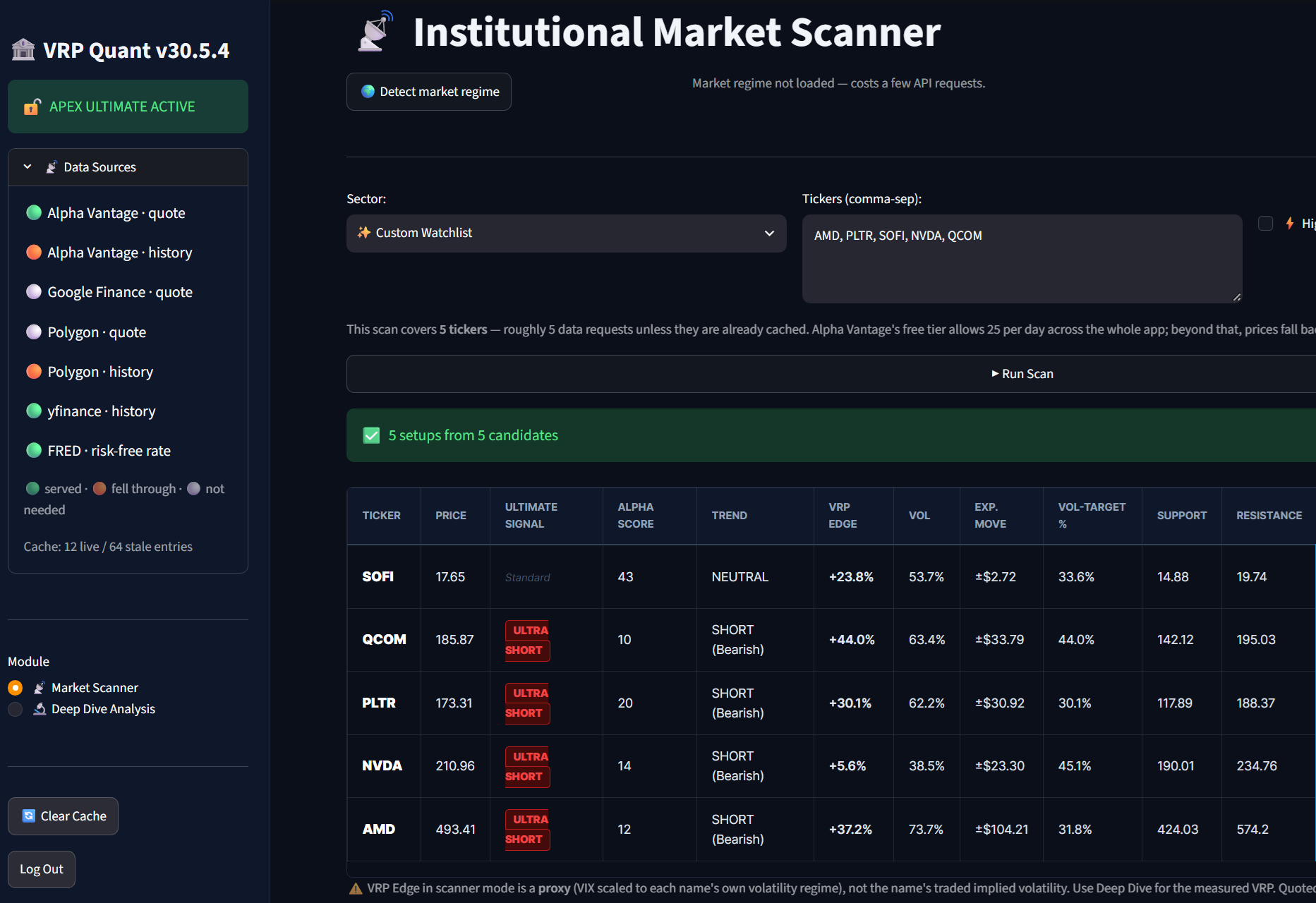
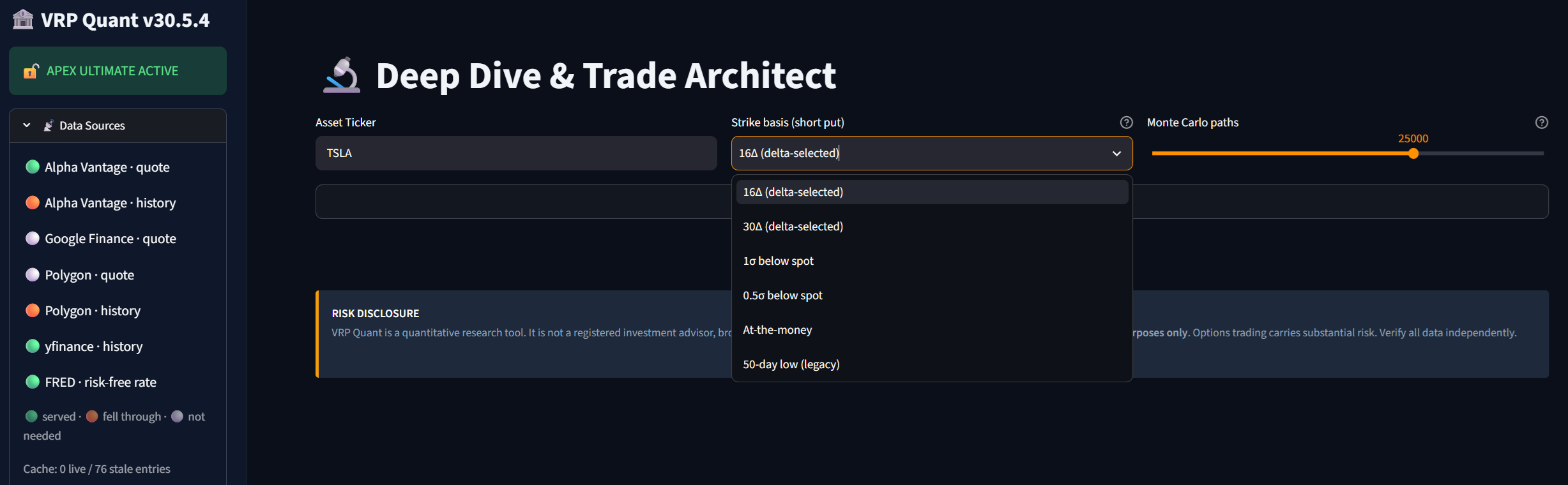
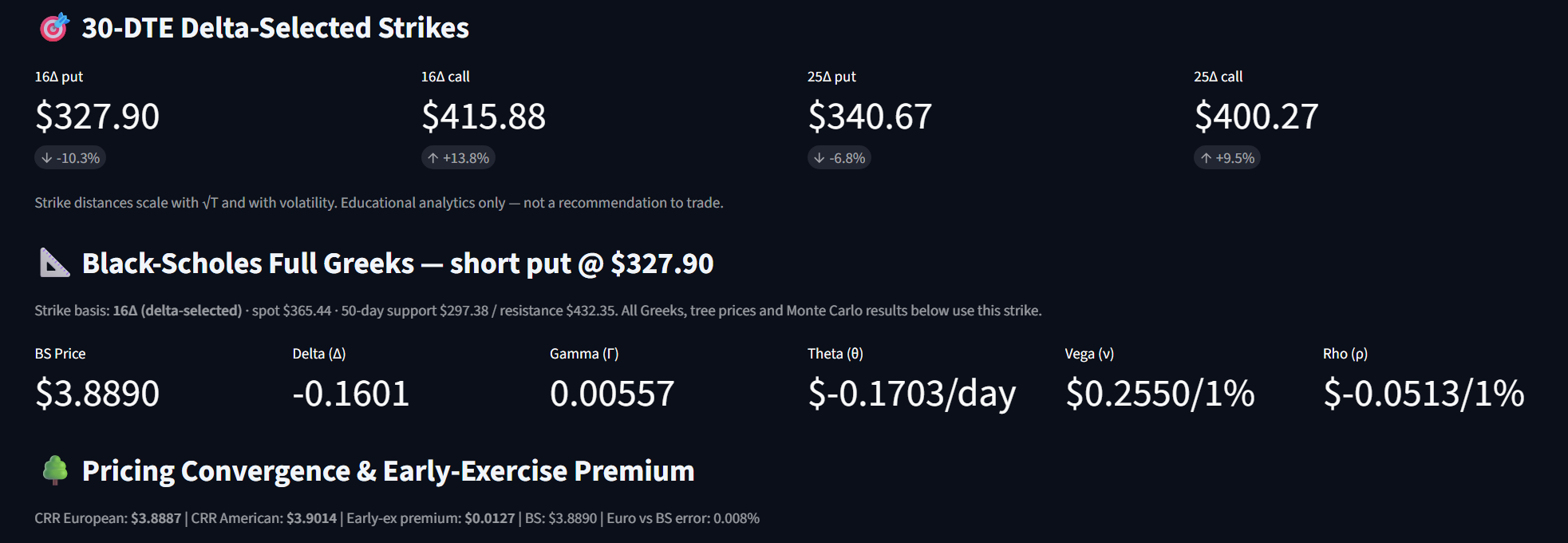
Proof that runs in public on every commit.
No market data, no API keys, no network. Each check is a closed-form identity or a convergence property — true or false independently of any market view. The suite exits non-zero on failure, so a passing run cannot be a silent one.
| Property tested | Result |
|---|---|
| Put-call parity across dividend yields | Holds |
| Dividend yield applied exactly once | Exact |
| CRR European convergence to Black-Scholes | 0.003% @ 200 |
| American ≥ European, early exercise non-negative | Holds |
| One-sigma bands vs true lognormal quantile | Exact |
| One-sigma breach probability vs theory | 15.87 / 15.87 |
| Volatility estimator independent of input length | Stable |
| Monte Carlo memory bounded at maximum paths | 48 MB @ 50k |
These establish that the arithmetic is correct. They say nothing about whether any given trade is profitable, and are not offered as though they did.
Founding cohort. Two tiers, one rate that doesn't move.
Founding rates below. They rise for members who join after the cohort closes; yours does not increase while your subscription stays active. That is not a marketing device — PayPal subscription plans are fixed price, so the figure you subscribe at is the figure that bills, permanently, on that plan.
- Institutional Market Scanner, full universe
- Deep Dive with all six strike bases
- Black-Scholes Greeks and CRR convergence panel
- Monte Carlo to 10,000 paths
- Six-source data waterfall with health reporting
- Everything in Analyst
- Monte Carlo to 50,000 paths with Merton jump diffusion
- GARCH(1,1) forecasting, walk-forward out of sample
- Regime detection and sector strength
- Custom watchlists and the APEX-100 universe
Ask before you subscribe.
Questions about methodology, data sources, what a tier includes, or billing — access@vrpquant.com. A person reads it.
What that address will not do is tell you whether to put on a specific trade. VRP Quant is a research tool, not an advisor, and answering individual position questions would make it something it is not registered to be. Ask how a number is computed and you will get a real answer. Ask whether to sell a particular put and you will get this paragraph back.
Straight answers, including the ones that don't sell harder.
Does the verification report mean the signals make money?
No, and it is not offered as though it does. It proves the pricing mathematics is correct. Pricing an option right is a necessary condition for the tool to be worth anything and not a sufficient one. Anyone conflating the two is selling you something.
Is there a backtest with a return figure?
The terminal runs a walk-forward out-of-sample backtest and shows it inside the product with a hypothetical-performance disclaimer attached. Those numbers are not reproduced on this page, because a simulated result presented as marketing is a performance claim and this is a research tool, not a track record.
Where does the data come from?
Six sources in a defined waterfall. Free-tier limits are real and the terminal tells you when it hits one rather than silently substituting stale data. The sidebar reports which source served each request.
Can I verify the report myself?
Yes. It is generated by the test suite in the repository and run by GitHub Actions against the commit named in its header. The report names the engine version it certifies, and the terminal shows its version in the sidebar. Where the two agree, the software you are using is the software that was proven.
Will the founding rate go up later?
Not for you. PayPal subscription plans are fixed price, so the rate you subscribe at is the rate that bills for as long as the subscription stays active. New members joining after the cohort closes pay the standard rate. Cancel and rejoin later and you rejoin at whatever is current, so the lock holds only while the subscription runs uninterrupted.
Does it place trades?
No. There is no broker connection, no order routing and no execution of any kind. It is a research terminal. You take your own decisions to your own broker.